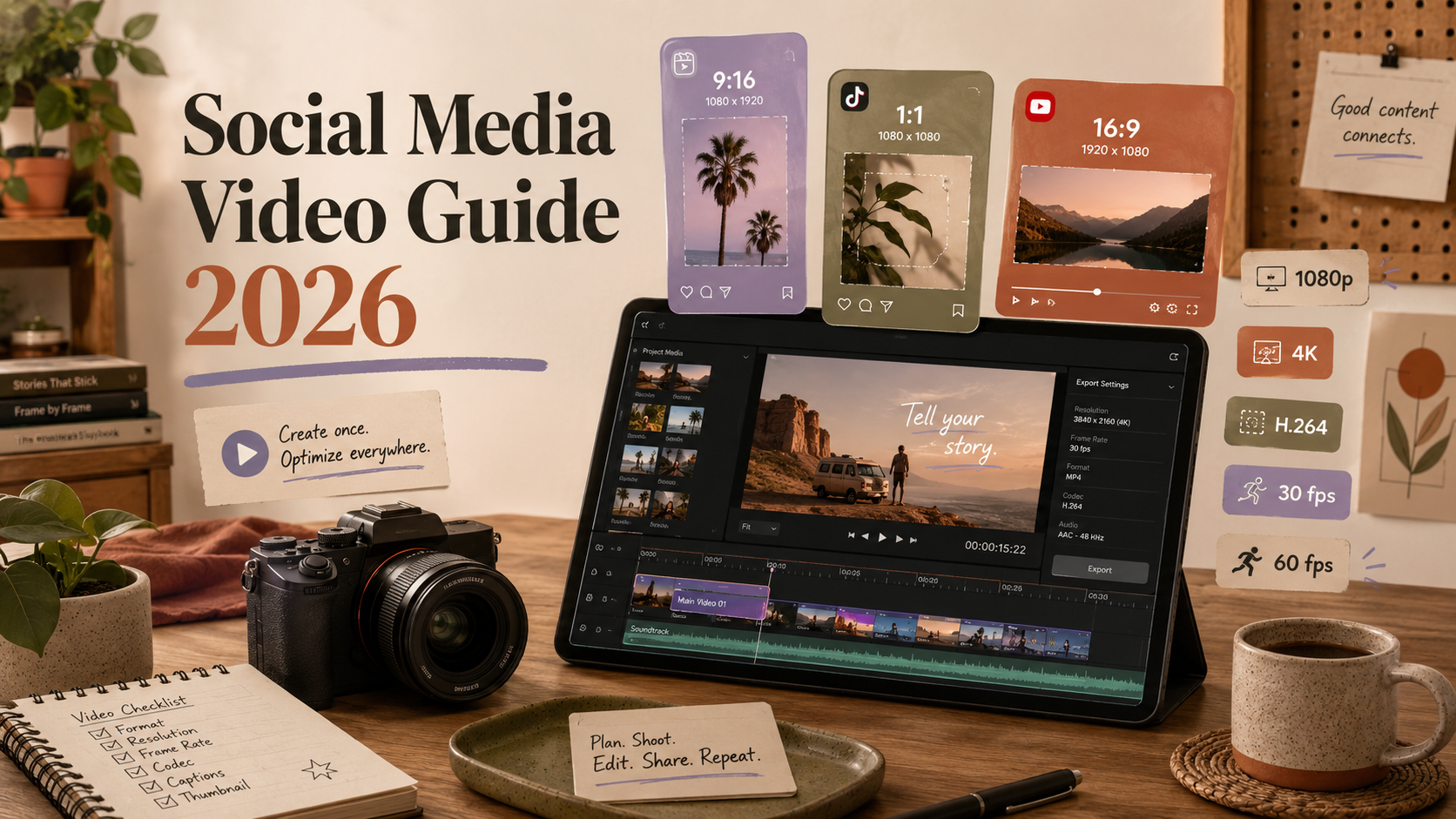
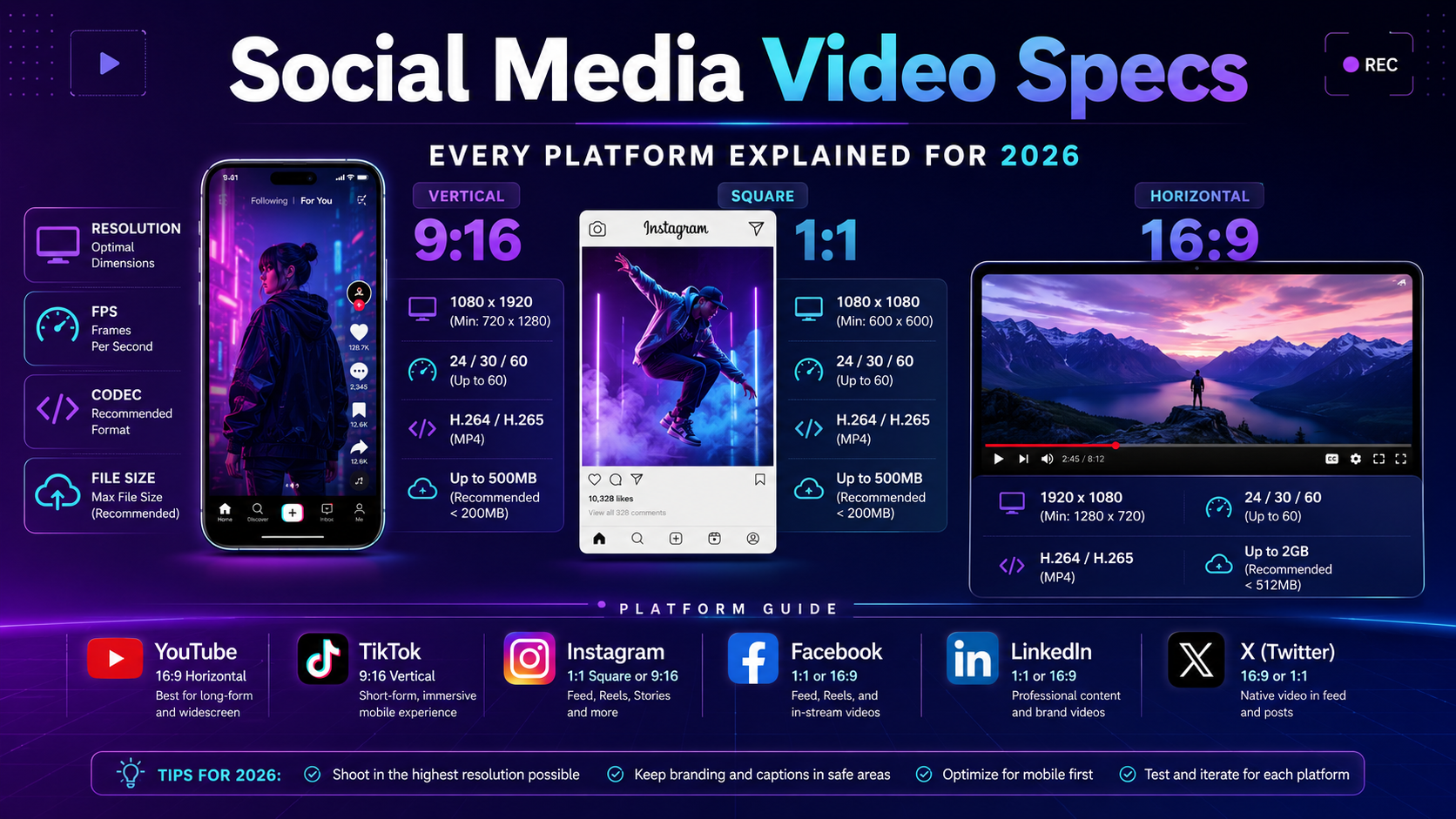
Video is now the dominant content format on every major social platform. But each platform has its own rules — different aspect ratios, file size limits, codec requirements, and maximum durations. Get these wrong and your video gets rejected, compressed into a blurry mess, or wrapped in black bars. This guide covers everything you need to know for 2026.
Key Video Specs to Understand
Before diving into platform-by-platform specs, here are the key terms you'll see throughout this guide:
Resolution — the pixel dimensions of your video (e.g. 1920×1080). Higher is sharper, but large files take longer to upload and process.
Aspect Ratio — the width-to-height ratio (e.g. 16:9 for landscape, 9:16 for vertical). This determines how the video fills the screen.
Frame Rate — how many frames per second (fps). 24fps looks cinematic, 30fps is standard, 60fps is smooth for action.
Codec — the compression format. H.264 (MP4) is universally accepted. H.265 (HEVC) offers better quality at smaller sizes but isn't accepted everywhere.
Bitrate — how much data per second. Higher bitrate = better quality, larger file.
Max File Size — the platform's upload limit. This is often the binding constraint for long videos.
YouTube Video Specs
YouTube supports the widest range of formats of any platform and handles transcoding well — it will process almost anything you upload. That said, uploading in H.264 at the target resolution saves time and ensures the best quality during YouTube's processing.
Video Type
Resolution
Aspect Ratio
Max Duration
Max File Size
Recommended Codec
Standard Video
Up to 3840×2160 (4K)
16:9
12 hours
256 GB
H.264 / MP4
YouTube Shorts
1080×1920
9:16
3 minutes
256 GB
H.264 / MP4
Live Stream
Up to 1920×1080
16:9
12 hours
—
H.264
YouTube tipUpload at native 4K even if your content is 1080p — YouTube applies a higher-quality codec (VP9) to 4K uploads, which results in a sharper 1080p stream than uploading at 1080p directly.
TikTok Video Specs
TikTok is built around vertical 9:16 video. Horizontal and square videos work but are displayed with blurred side bars — vertical always performs better. TikTok's compression is aggressive, so export your video at the highest quality setting before uploading.
Video Type
Resolution
Aspect Ratio
Max Duration
Max File Size
Recommended Codec
Feed Video
1080×1920
9:16
10 minutes
4 GB
H.264 / MP4
TikTok Live
1080×1920
9:16
Unlimited
—
H.264
Story
1080×1920
9:16
15 seconds
—
H.264 / MP4
Instagram Video Specs
Instagram has several different video formats — Reels, Stories, and feed videos — each with different constraints. Reels is Instagram's primary discovery surface, so it's worth optimizing for it specifically.
Video Type
Resolution
Aspect Ratio
Max Duration
Max File Size
Notes
Reels
1080×1920
9:16
3 min (in-app) / 20 min (upload)
4 GB
UI safe zone: leave 14% top/bottom
Feed Video
1080×1080
1:1
60 minutes
4 GB
Also supports 4:5 portrait
Story Video
1080×1920
9:16
60 seconds
4 GB
Per clip; can chain clips
Live Video
1080×1920
9:16
4 hours
—
Reels tipThe bottom 35% of a Reel is covered by the caption, audio bar, and action buttons. Keep your most important visuals in the top half of the frame.
Facebook Video Specs
Video Type
Resolution
Aspect Ratio
Max Duration
Max File Size
Notes
Feed Video
1920×1080
16:9
240 minutes
4 GB
Since June 2025, all Feed Videos are published as Reels
Facebook Reels
1080×1920
9:16
No length restriction
4 GB
Story Video
1080×1920
9:16
60 seconds
4 GB
Live Video
1920×1080
16:9
8 hours
—
In-stream Ad
1080×1920
9:16
15 seconds
—
Preferred for mobile feed
X (Twitter) Video Specs
Video Type
Resolution
Aspect Ratio
Max Duration
Max File Size
Notes
In-stream Video
1280×720 min, 1920×1080 max
16:9 / 1:1 / 9:16
2m 20s (free); up to 4h (X Premium)
512 MB (free); up to 16 GB (X Premium Plus)
MOV or MP4; H.264 + AAC
X Live
720p minimum
16:9
Unlimited
—
LinkedIn Video Specs
LinkedIn video skews toward professional content — product demos, talks, and thought leadership. Square (1:1) and portrait (4:5) formats perform well in the LinkedIn feed because they take up more space without requiring the user to go full-screen.
Video Type
Resolution
Aspect Ratio
Max Duration
Max File Size
Notes
Feed Video
256×144 min, 4096×2304 max
1:2.4 to 2.4:1
10 min (mobile) / 15 min (desktop)
5 GB
H.264 / MP4 recommended
LinkedIn Live
1920×1080 min
16:9
4 hours
—
Sponsored Video
1920×1080
16:9 or 1:1
30 minutes
200 MB
For ads
Snapchat Video Specs
Video Type
Resolution
Aspect Ratio
Max Duration
Max File Size
Notes
Snap / Story
1080×1920
9:16
60 seconds
32 MB
Auto-splits into ~10 second segments
Spotlight
1080×1920
9:16
3 seconds – 3 minutes
1 GB
Vertical video discovery
Snap Ad
1080×1920
9:16
3–180 seconds
1 GB
H.264 / MOV or MP4
H.264 MP4 is the universal codec — accepted by every major platform without transcoding issues
Quick Comparison: All Platforms
Platform
Best Resolution
Best Aspect Ratio
Max Duration
Max File Size
YouTube
3840×2160 (4K)
16:9
12 hours
256 GB
TikTok
1080×1920
9:16
10 minutes
4 GB
Instagram Reels
1080×1920
9:16
3 min (in-app) / 20 min (upload)
4 GB
Instagram Feed
1080×1080
1:1
60 minutes
4 GB
Facebook
1920×1080
16:9
240 minutes
4 GB
X (Twitter)
1920×1080
16:9
2m 20s (free) / 4h (Premium)
512 MB (free) / 16 GB (Premium Plus)
LinkedIn
1920×1080
1:1
10 min (mobile) / 15 min (desktop)
5 GB
Snapchat
1080×1920
9:16
60 seconds
1 GB
Universal adviceExport in H.264 (MP4) at the highest quality your file size allows. It's the one codec accepted everywhere. Use AAC audio at 48kHz. For vertical video (9:16), plan your composition so the subject is centered — most platforms layer UI elements over the top and bottom 15% of the frame.